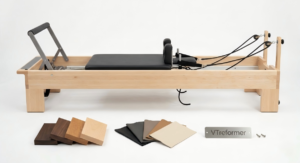
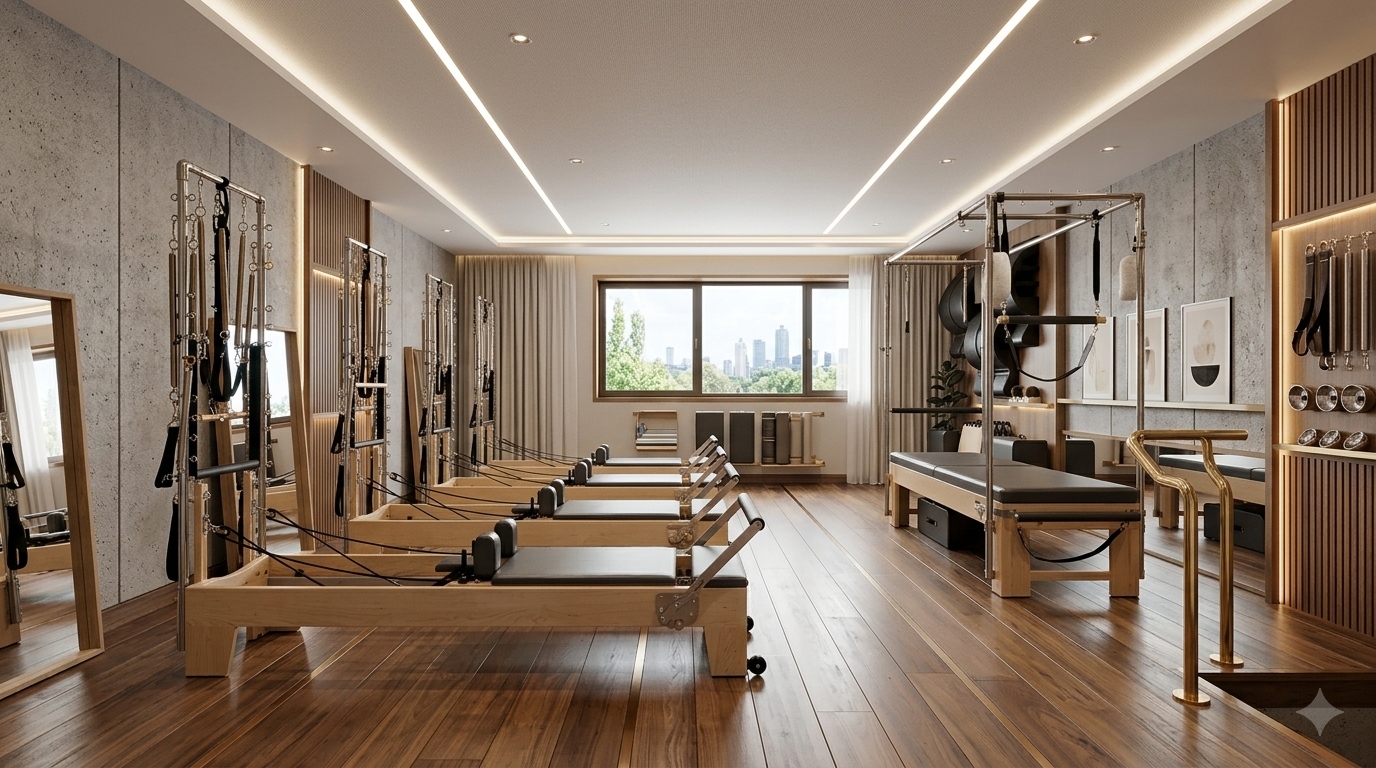
A new studio should buy enough Pilates reformers for its realistic launch class size, provided that the room can accommodate them safely and the business can afford the full landed and operating cost.
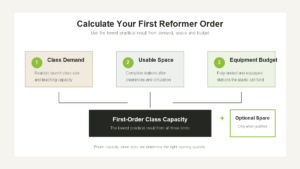
There is no universal number. Base the first order on class demand, usable space and equipment budget. The lowest practical result usually determines launch capacity.

Use three limits to calculate your first order
Calculate these three numbers separately:
- Demand-based quantity: the number of clients you realistically plan to teach in one reformer class.
- Space-based maximum: the number of complete reformer stations that fit within the usable training room.
- Budget-supported quantity: the number of fully equipped and delivered stations the business can afford.
Use this decision rule:
Recommended first-order capacity = the lowest practical result from class demand, usable space and equipment budget
Then consider a spare:
Final purchase quantity = recommended class capacity + justified spare allowance
A room may fit ten reformers, but that does not mean a new studio should buy ten on opening day.
Step 1: Set a realistic launch class size
Start with your teaching model: private sessions, semi-private training or group reformer classes. Decide how many clients one instructor can supervise effectively.
Next, separate three different figures:
- Maximum class capacity: every available client place is occupied.
- Expected attendance: the average number of clients who attend.
- Peak demand: recurring periods when bookings approach full capacity.
Your initial quantity should support the class size you can realistically sell and operate. Review founding memberships, pre-opening inquiries and the planned timetable. If evidence supports six-person launch classes, six active reformers may be more sensible than ten for unvalidated future demand.
If the studio also offers mat, chair or private sessions, not every room or instructor needs to serve reformer groups.
Step 2: Calculate how many reformers fit in the room
Subtract reception, toilets, offices, storage, changing areas, columns and other fixed uses from the leased area. The remainder is the usable reformer training area.
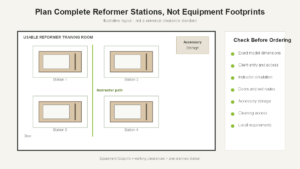
Draw the selected reformer to scale, then add space for client access, instructor movement, adjustments and accessory storage.
Check:
- entrances, door swings and exit routes;
- columns and fixed equipment;
- instructor circulation;
- client access to each station;
- boxes, jump boards and accessory storage;
- cleaning and maintenance access;
- accessible routes where required;
- extra height or clearance for tower configurations.
| Measurement | Metric | Imperial |
|---|---|---|
| Total studio area | square meters | square feet |
| Non-training area | square meters | square feet |
| Usable reformer room | square meters | square feet |
| Selected reformer size | meters | feet and inches |
| Planned station area | square meters | square feet |
Useful conversions:
1 square meter = approximately 10.764 square feet1 square foot = approximately 0.0929 square meters
Your planning formula is:
Space-based maximum = usable reformer training area / planned area per complete station
The planned station area is a layout assumption, not a universal safety clearance. Final spacing must reflect the selected equipment, teaching method, building conditions and applicable local requirements.
Step 3: Check what the startup budget can support
Calculate the landed cost of each reformer with required accessories and delivery.
Landed cost per station = reformer + required accessories + allocated logistics + import costs + installation + initial spare parts
Then calculate:
Budget-supported quantity = dedicated equipment budget / landed cost per station
Round the result down to a whole purchasable unit.
Keep equipment funds separate from the total startup budget, which must also cover fit-out, software, insurance, staffing, marketing and working capital.
Request an itemized quotation for the configuration, quantity and destination instead of multiplying an advertised base price.
Worked example for a new Pilates studio
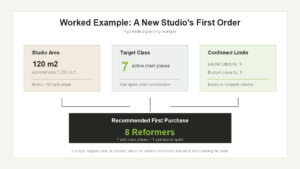
Consider a hypothetical studio with:
- total leased area of
120 m2 / approximately 1,292 sq ft; 55 m2 / approximately 592 sq ftused for reception, toilets, office, storage and other functions;- usable reformer training space of
65 m2 / approximately 700 sq ft; - a target launch class of seven clients;
- a budget that supports eight fully landed and equipped stations.
After drawing the selected reformer to scale and adding the studio’s required working clearances, the designer confirms that the room can accommodate eight stations.
The three results are:
- demand supports seven active stations;
- the layout supports eight stations;
- the equipment budget supports eight stations.
A reasonable first purchase is eight reformers: seven sold places and one spare. If the budget supports only six, launch with six and adjust the class model rather than overcrowding the room or underfunding the business.
Should a new studio buy a spare reformer?
A spare is useful when full classes are frequent and one unavailable unit would displace a paying client. It may also support assessments or private sessions.
Consider a spare when:
- full-capacity classes are expected regularly;
- replacement parts may take time to arrive;
- equipment downtime could cause refunds or cancellations;
- the purchase does not weaken essential working capital.
Defer it while validating demand or protecting launch funds. Do not count a spare as an additional sellable class place.
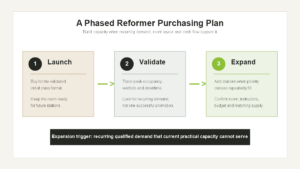
Use phased purchasing instead of filling the room immediately
Phase 1: Launch
Buy enough for the validated initial class format and leave a clear expansion path.
Phase 2: Validate
Track peak occupancy, waitlists, instructor capacity, downtime and expansion cash. Look for recurring demand rather than one successful promotion.
Phase 3: Expand
Review expansion when priority classes repeatedly reach capacity and turn away demand. Confirm that the room, instructors and budget can support more stations, and that later units can match the original configuration.
Common planning mistakes
- Using total lease area instead of usable training area.
- Measuring the reformer without its working and circulation space.
- Assuming every class will be full immediately.
- Buying different models that slow instructor transitions.
- Spending the entire startup budget on equipment.
- Treating a spare as another sellable class place.
- Forgetting boxes, jump boards and accessory storage.
- Failing to confirm whether later orders can match the first batch.
- Ignoring delivery access, door dimensions and final assembly.
Frequently asked questions
How much space is needed for each Pilates reformer?
Start with the reformer’s exact dimensions, then add working and circulation space for the class format, instructor access and local requirements.
Can I start with fewer reformers and add more later?
Yes. Confirm that the room supports phased expansion and that the supplier can reproduce the original model, finish, spring setup and accessories.
How do I calculate reformer capacity from room size?
Subtract non-training areas, draw each selected reformer to scale and add operational clearances. The complete stations that fit represent the space-based maximum, not automatically the ideal purchase quantity.
What should I send to a reformer supplier?
Send your usable training area, floor plan if available, target class size, preferred configuration, required accessories, quantity range, destination and target opening date.
Find the right equipment for your studio
Your first order should support realistic demand, fit the usable room and preserve startup funds. Add a spare only when justified.
VTreformer offers studio reformer configurations in wood and aluminum, with equipment and accessories selected according to the project. The minimum order quantity starts from one set.
Find the Right Equipment for Your Studio
Send us your usable training area, target class size, preferred configuration, destination and opening schedule. The VTreformer team can help you compare suitable equipment options and prepare the information required for a project quotation.
Final layout, local compliance and business decisions remain the buyer’s responsibility.

-300x218.jpg)