
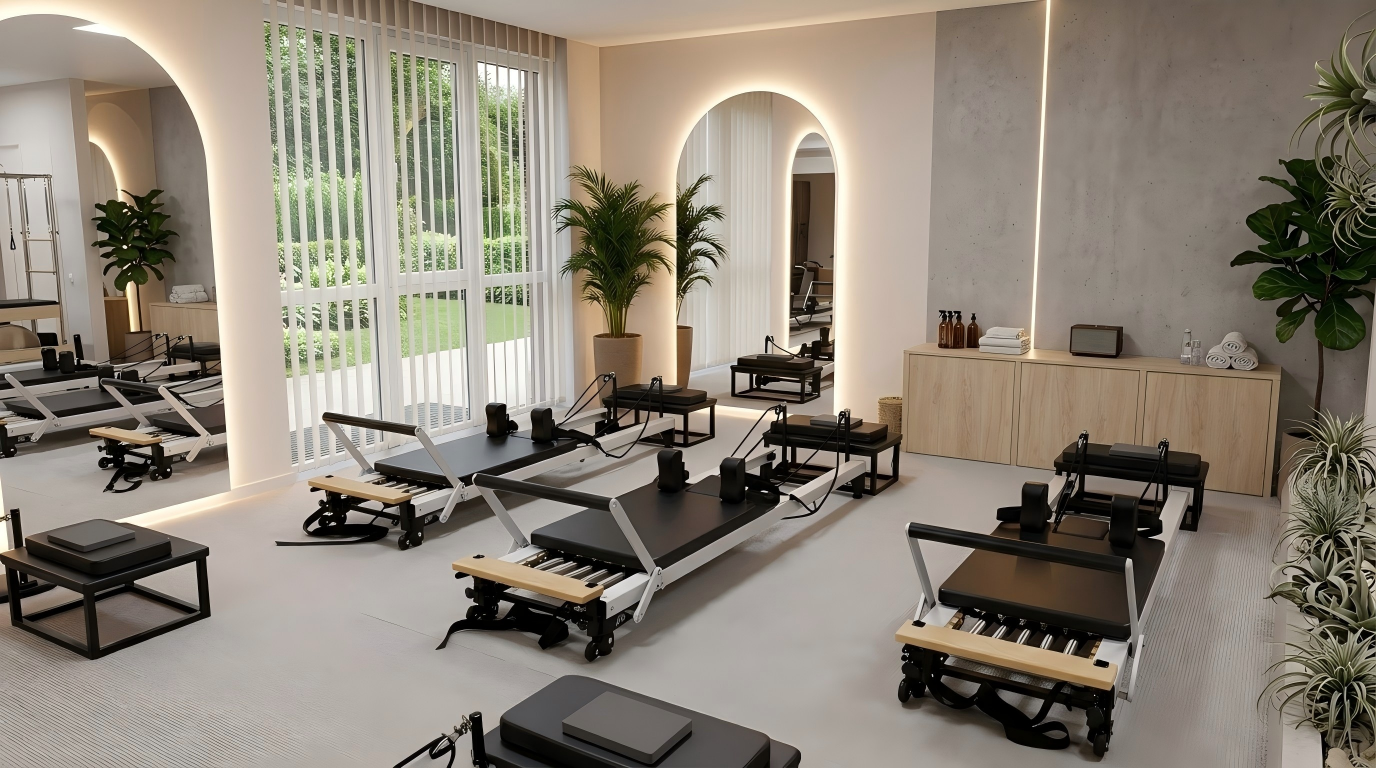
A wrong reformer looks fine on day one. Then it becomes noisy, loose, and hard to repair. I see this mistake often.
I believe the best commercial Pilates reformer is the one that lowers business risk. It should stay stable, quiet, smooth, and safe under daily use. It should also have serviceable parts, clear documents, reliable supply, and a fit with your real business model.
I do not see “best” as a simple brand name. I see it as a purchasing decision with real costs after the invoice is paid. In my work at VTreformer, I speak with studio owners, wholesalers, agents, online sellers, and rehab buyers. Many people first ask me for a famous model or the lowest price. After a few questions, the real concern appears. They want fewer complaints. They want fewer repairs. They want stable supply. They want a reformer that can support daily business.
Why should I treat “best” as a commercial risk question?
Many buyers compare reformers like home furniture. I think that creates trouble. A commercial reformer must survive sweat, weight, speed, and repeated classes.1
I treat the best commercial Pilates reformer as a risk-control tool. I check whether it can reduce noise, shaking, service calls, replacement delays, user complaints, and supply problems2 during long-term business use.
I first ask what kind of risk the buyer wants to reduce
When a buyer asks me, “Which reformer is best?” I usually ask where the reformer will be used. I ask how many classes happen each day. I ask who will maintain the machines. I ask whether the buyer needs OEM branding, fast replenishment, or export packaging. These questions matter because a commercial reformer is not only a training tool. It is also part of a business system. If one reformer breaks in a busy studio, the owner may lose one class. If ten reformers make noise, the brand image may suffer. If a wholesaler cannot get spare parts, the local customer may stop reordering. I have seen buyers save a small amount at the start and then pay more through downtime, complaints, and urgent parts shipping.
| Commercial risk I check | Why I check it | What I usually ask the buyer to confirm |
|---|---|---|
| Shaking during use | It affects user trust and class quality | Frame structure, rail support, load rating, test data |
| Noise after months | It creates complaints in studios | Wheel quality, pulley design, spring movement, assembly accuracy |
| Hard repairs | It increases downtime | Spare parts list, replacement method, tool needs |
| Supply delay | It affects expansion and resale | Lead time, MOQ, packaging plan, reorder cycle |
| Wrong documents | It blocks some buyers or markets | CE, ISO9001, RoHS, order-specific documents |
I never suggest that one reformer is the best for everyone. I suggest that each buyer defines the risk first. Then I match the reformer to that risk.
A reformer can look beautiful in photos. I still need to know what is under the carriage, inside the frame, and behind the smooth movement.
I recommend checking frame strength, rail smoothness, carriage stability, pulley quality, spring durability, upholstery, noise control, and replaceable accessories3. These hidden details often decide whether a reformer works well after heavy use.
I look beyond the surface finish
I have learned that many problems start from small parts that buyers do not notice at first. The frame must resist movement when users change positions fast. The rails must keep the carriage smooth after many sessions. The wheels must roll quietly without uneven wear. The pulley system must stay aligned, because a poor angle can create rough rope movement.4 Springs must give stable resistance and should be easy to replace when they reach their service life. Upholstery must be easy to clean and strong enough for commercial use. Soft parts should not tear early. Accessories should be replaceable, not decorative items that become impossible to source later.
| Quality area | What I check | Why it matters in daily use |
|---|---|---|
| Frame | Material, joint strength, support design | I want less shaking and longer service life |
| Rails and carriage | Smooth travel, wheel fit, side movement | I want quiet motion and better user feel |
| Pulley system | Alignment, bearing quality, rope path | I want steady resistance and less friction |
| Springs | Consistency, coating, replacement access | I want predictable resistance and easier maintenance |
| Upholstery | Cleaning surface, stitching, foam support | I want better hygiene and fewer visual defects |
| Accessories | Standard parts, stock availability | I want faster repair and less downtime |
I also tell buyers to confirm details with the latest product specification sheet. Load rating, warranty terms, parts lifespan, test data, and materials can change by model and order. A serious supplier should be willing to explain these details in plain words.
How should I choose a reformer for studios, rehab centers, or wholesale?
A studio owner, a rehab buyer, and a wholesaler do not face the same problem. I think their “best” reformer should be different.
I recommend matching the reformer to the buyer type. Studios need durable and low-maintenance equipment. Rehab and physio buyers need stable, cleanable, and well-documented products. Wholesalers need price tiers, parts supply, packaging, and repeatable lead times.
I match the reformer to the business model
When I speak with a chain studio owner, I focus on daily class pressure. The reformer must feel consistent from one machine to another. The owner also needs simple maintenance because staff may not be technicians. When I speak with a rehab or physio procurement team, I focus more on stability, cleanability, safe operation, and documents. I do not make medical claims. I simply help the buyer check whether the equipment package, product data, and compliance documents match their purchasing process. When I speak with wholesalers, agents, Amazon sellers, or Shopify brand owners, I focus on supply. They need stable production, export packaging, OEM support, and spare parts planning. Their risk is not only product failure. Their risk is also customer complaints at scale.
| Buyer type | Main concern I hear | Reformers should prioritize |
|---|---|---|
| Single studio | User experience and maintenance | Quiet movement, durable parts, easy service |
| Chain studio | Consistency across locations | Stable batch quality, repeat orders, spare parts |
| Rehab or physio center | Safety, hygiene, documents | Stability, cleanable surface, documentation support |
| Wholesaler or agent | Margin and supply reliability | Price tiers, lead time, packaging, parts stock |
| Online private-label seller | Brand control and reviews | OEM options, product consistency, after-sales plan |
| High-end personal buyer | Quality and value | Smooth feel, strong build, clear story |
I advise buyers to list their business needs before comparing prices. A wholesale buyer should verify MOQ, lead time, carton design, spare parts policy, and customization scope. A studio buyer should verify warranty, repair process, parts availability, and expected maintenance. A rehab buyer should verify certificates and documents per region and order.
Why does lifecycle cost matter more than unit price?
A low price feels safe when the order is placed. I have seen it become expensive when the reformer causes repairs, delays, and complaints.
I compare reformers by lifecycle cost, not only unit price.5 The real cost includes repairs, downtime, spare parts, freight, warranty handling, user complaints, and the time needed to manage problems.6
I calculate what happens after delivery
Many buyers ask for the lowest price first. I understand this. Budget matters. But I also ask what happens if a reformer needs frequent service. If a studio cancels classes, the lost revenue may be higher than the saved purchase cost.7 If a wholesaler ships products with weak packaging, damage claims can erase the margin.8 If replacement parts are not stocked, a simple repair can take weeks. If a private-label seller receives poor reviews, the platform ranking may suffer. I think a good commercial reformer should make the owner’s work easier after delivery. It should not become a hidden job.
| Cost item | Low upfront price risk | Better commercial buying approach |
|---|---|---|
| Repairs | More small failures may appear | Check structure, moving parts, and service access |
| Downtime | Classes or customer use may stop | Keep spare parts and clear repair steps |
| Freight damage | Weak packing may create claims | Confirm export packaging and drop concerns |
| Reviews | Poor feel may create complaints | Test smoothness, noise, and finish before order |
| Reorders | Inconsistent batches may hurt brands | Confirm batch quality control and lead time |
| Warranty handling | Unclear terms cause arguments | Confirm warranty scope per order in writing |
I do not tell buyers to always buy the most expensive reformer. I tell them to connect price with durability, serviceability, and supply. A fair price should include better control of materials, inspection, packaging, and after-sales support. Before ordering, I suggest confirming price, warranty, load rating, parts lifespan, and test data with current documentation.
When is VTreformer a suitable commercial reformer supplier?
Some buyers only need one display model. Other buyers need a controlled supply chain. I know VTreformer fits the second group better.
I see VTreformer as a suitable option for buyers who value source-factory control, OEM/ODM support, quality inspection, export packaging, spare parts planning, and stable commercial supply, but I do not claim it is best for every buyer.
I explain where our factory role helps
I write from the view of a source Pilates equipment manufacturer. VTreformer is based in Suzhou, Anhui, China. We have 8 years of manufacturing experience. Our factory covers about 20,000 square meters. We operate 12 automated production lines. Our team includes more than 200 people, with sales staff, customer service, designers, and front-line workers. We hold CE, ISO9001, RoHS, and product patent-related qualifications. Buyers should still confirm the exact certificate scope and latest documents before each order, because market requirements can differ. I mention these points because they affect business buying. A commercial buyer often needs repeat supply, stable inspection, custom branding, and after-sales parts. A factory with controlled production can help reduce some of those risks.
| Buyer need | How a source factory can help | What I still ask buyers to verify |
|---|---|---|
| OEM branding | Logo, color, packaging, product details | Customization scope, MOQ, sample approval |
| Stable supply | Production planning and repeat batches | Current lead time and order schedule |
| Quality control | Inspection before shipment | Test items, inspection standard, reports |
| Export needs | Packaging and shipping support | Carton design, pallet plan, destination rules |
| After-sales | Spare parts and service support | Warranty terms, parts list, response process |
| Compliance | Document support | Region-specific certificate needs |
I prefer honest fit over hard selling. If a buyer wants a very small one-time order with no commercial plan, another channel may be enough. If a buyer wants private-label supply, studio expansion, wholesale replenishment, or more controlled after-sales support, then I think VTreformer is worth comparing. I also encourage buyers to request the current specification sheet, sample policy, MOQ, lead time, warranty terms, packaging details, and available customization options before making a decision.
What questions should I ask before I place a commercial reformer order?
A rushed order can hide many weak points. I have seen buyers discover missing details only after the goods arrive.
I suggest asking clear questions about use level, materials, load rating, warranty, spare parts, lead time, MOQ, certificates, customization, packaging, inspection, and after-sales service before placing a commercial reformer order.
I use a checklist before I confirm a buyer’s plan
I like simple questions because they prevent complex problems. I ask how many users will use the reformer each day. I ask whether the buyer needs one model or several models. I ask whether the reformers will be used in a studio, clinic, hotel gym, resale channel, or home. I ask who will handle repairs locally. I ask whether spare parts should be shipped with the order. I ask whether the buyer needs a sample first. These questions help both sides avoid wrong expectations. A commercial order is not only about one product. It is about delivery, documents, packaging, training for maintenance, and repeat support.
| Question I ask | Why I ask it | What the buyer should request |
|---|---|---|
| How many sessions per day? | I need to judge use intensity | Commercial-use recommendation |
| What market will receive the goods? | I need to check document needs | Latest certificate and compliance files |
| Do you need OEM/ODM? | I need to plan production details | Logo, color, label, packaging confirmation |
| What is the target budget? | I need to match price and durability | Clear quotation with included items |
| Do you need spare parts? | I need to reduce downtime risk | Parts list and suggested spare set |
| What is the delivery plan? | I need to plan factory schedule | MOQ, lead time, shipping terms |
| How will you inspect goods? | I need to align quality expectations | Inspection standard and photos or video |
I recommend getting every key point in writing. Price, MOQ, lead time, warranty, load rating, customization scope, parts lifespan, packaging method, and test data should be confirmed based on the current order and current product documents.
Conclusion
I choose the best commercial Pilates reformer by risk, not fame. I check durability, serviceability, supply, documents, and lifecycle cost first.
"[PDF] DoD MWR Fitness Standards FY25.pdf", https://dodmwrandresalepolicy.defense.gov/Portals/104/Documents/MWR%20Standards/DoD%20MWR%20Fitness%20Standards%20FY25.pdf?ver=9UwJZwKJRZnTv8nYPiROIg%3D%3D. Facility safety and maintenance guidance for health and fitness settings treats exercise equipment as a managed asset that must withstand repeated use and be inspected and maintained to reduce user risk. Evidence role: general_support; source type: institution. Supports: Commercial fitness equipment should be selected and maintained with attention to repeated use, user safety, and facility operating conditions.. Scope note: This would support the general commercial-equipment principle rather than provide Pilates-reformer-specific load or durability data. ↩
"Optimal Periods of Conducting Preventive Maintenance to ...", https://pmc.ncbi.nlm.nih.gov/articles/PMC8913151/. Research on equipment maintenance and reliability describes preventive maintenance as a method for reducing failures, downtime, and operational disruptions in service environments. Evidence role: general_support; source type: research. Supports: Preventive maintenance and equipment reliability practices are used to reduce downtime, defects, safety incidents, and service interruptions.. Scope note: The evidence would be contextual and would not quantify these risks specifically for Pilates reformers. ↩
"Effects of 12-week pilates reformer training on the ... - PMC - NIH", https://pmc.ncbi.nlm.nih.gov/articles/PMC12174401/. Biomechanical and equipment descriptions of Pilates reformers identify the moving carriage, rails, pulleys, ropes, and springs as functional elements that determine resistance delivery and movement control. Evidence role: mechanism; source type: paper. Supports: A Pilates reformer functions through an integrated carriage, rail, pulley, rope, and spring-resistance system, so component quality can affect smoothness, resistance, and stability.. Scope note: Such sources usually explain the apparatus mechanism and may not directly compare commercial product durability. ↩
"12.1 Pulley Problems - Part I, Set up the Equations | Physics", https://ocw.mit.edu/courses/8-01sc-classical-mechanics-fall-2016/pages/week-4-drag-forces-constraints-and-continuous-systems/12-1-pulley-problems-part-i-set-up-the-equations/. Engineering and physics treatments of pulley systems show that rope path, contact angle, and friction affect transmission efficiency and the force needed for motion. Evidence role: mechanism; source type: education. Supports: The direction of force, contact geometry, and friction in pulley systems influence the smoothness and efficiency of rope motion.. Scope note: This would support the mechanical principle behind the claim, not provide product-specific evidence for any reformer model. ↩
"TOTAL COST OF OWNERSHIP (TCO) 1. Facilities", https://www.chaffey.edu/purchasing/docs/tco-implementation-summary.pdf. Life-cycle costing frameworks define the cost of an asset as including purchase, operation, maintenance, and other costs incurred over its useful life, rather than purchase price alone. Evidence role: definition; source type: institution. Supports: Life-cycle costing evaluates acquisition costs together with operating, maintenance, repair, and disposal costs over the useful life of an asset.. Scope note: This supports the costing method generally and does not calculate the lifecycle cost of any reformer model. ↩
"Maintenance Costs and Advanced Maintenance Techniques ...", https://pmc.ncbi.nlm.nih.gov/articles/PMC9890517/. Total-cost-of-ownership literature treats equipment costs as extending beyond acquisition price to include maintenance, downtime, spare parts, logistics, and administrative costs. Evidence role: general_support; source type: paper. Supports: Total cost of ownership analyses include direct purchase costs and indirect costs such as maintenance, downtime, spare parts, logistics, and administrative burden.. Scope note: The source would support the cost categories conceptually, while the relative size of each cost would depend on the buyer’s operations. ↩
"How Much Does Downtime Cost Your Business?", https://truleap.net/how-much-downtime-costs-your-business/. Operations and maintenance research identifies equipment downtime as a source of financial loss because it interrupts service delivery and can reduce revenue-generating capacity. Evidence role: general_support; source type: research. Supports: Downtime caused by equipment failure can impose financial losses through interrupted service delivery and lost revenue opportunities.. Scope note: This would not prove that any specific studio’s lost revenue exceeds purchase savings; that comparison requires local pricing and utilization data. ↩
"[PDF] Load Securement and Packaging Methods to Reduce Risk of ...", https://repository.rit.edu/cgi/viewcontent.cgi?article=1008&context=japr. Logistics and packaging studies describe transport packaging as a determinant of product damage risk, with damage leading to replacement, claims, and handling costs. Evidence role: general_support; source type: paper. Supports: Packaging performance affects product damage rates in distribution, and damage can generate direct financial costs through claims, replacement, and handling.. Scope note: The support would be general to shipped goods and would not estimate damage rates for Pilates reformers without shipment-specific data. ↩